Towards Recovery
Private addiction-severity screening that flags risk for a human counsellor and never acts on its own.
- Status
- 2nd prizeGame of Code 2026
- Built for
- Game of Code 2026, Mauritius
- When
- June 2026
- Team
- Team project
- My role
- Team member
- Built with
- FastAPI, SQLite, Next.js 16, DeepFace, XGBoost, Gemini 2.0 Flash (summary only)
- Links
- Repository: private team repository
The problem
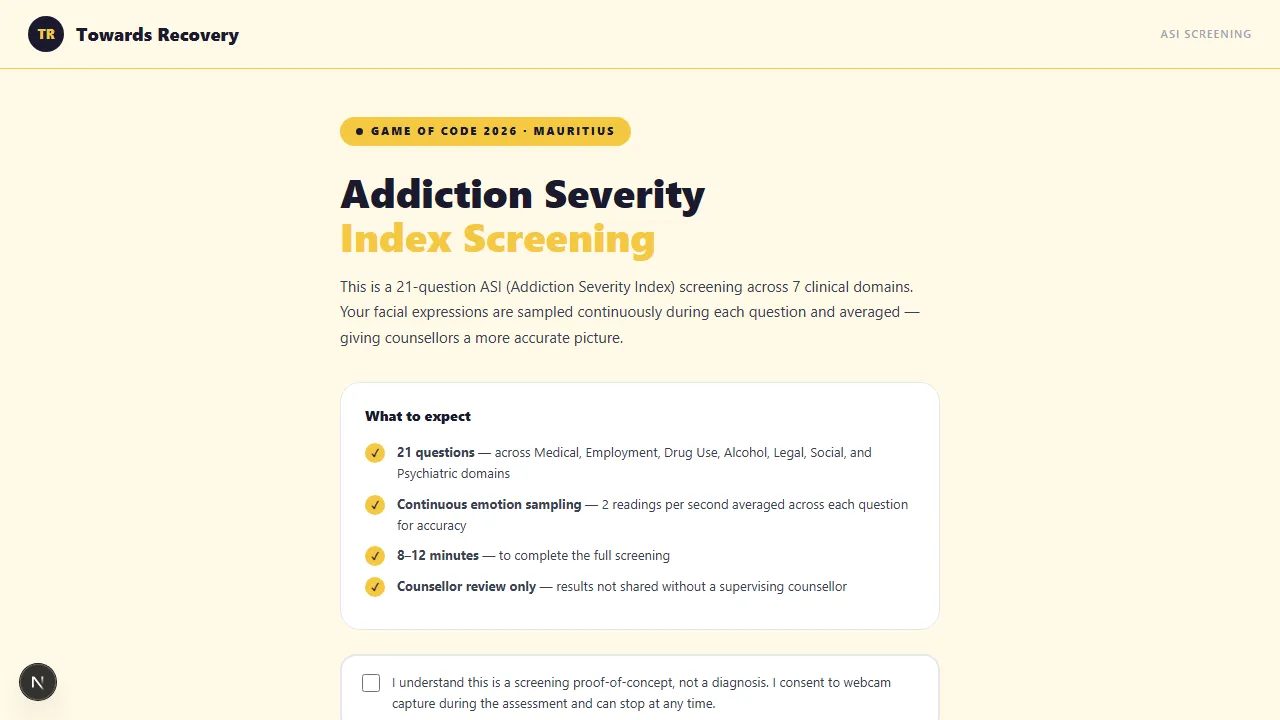
The Addiction Severity Index is the standard early screen, but it needs a trained clinician, and most people who need it never reach one. The team’s pitch named two problems: access and stigma. Towards Recovery brings an ASI-structured screen to the participant, in private, and keeps watching for change afterwards.
How it works
- A six-second resting-face calibration, then 21 questions across seven clinical domains: medical, employment, drug use, alcohol, legal, family and social, and psychiatric.
- The webcam is sampled while each question is answered, and readings are compared with the participant’s own resting face instead of a fixed “neutral”.
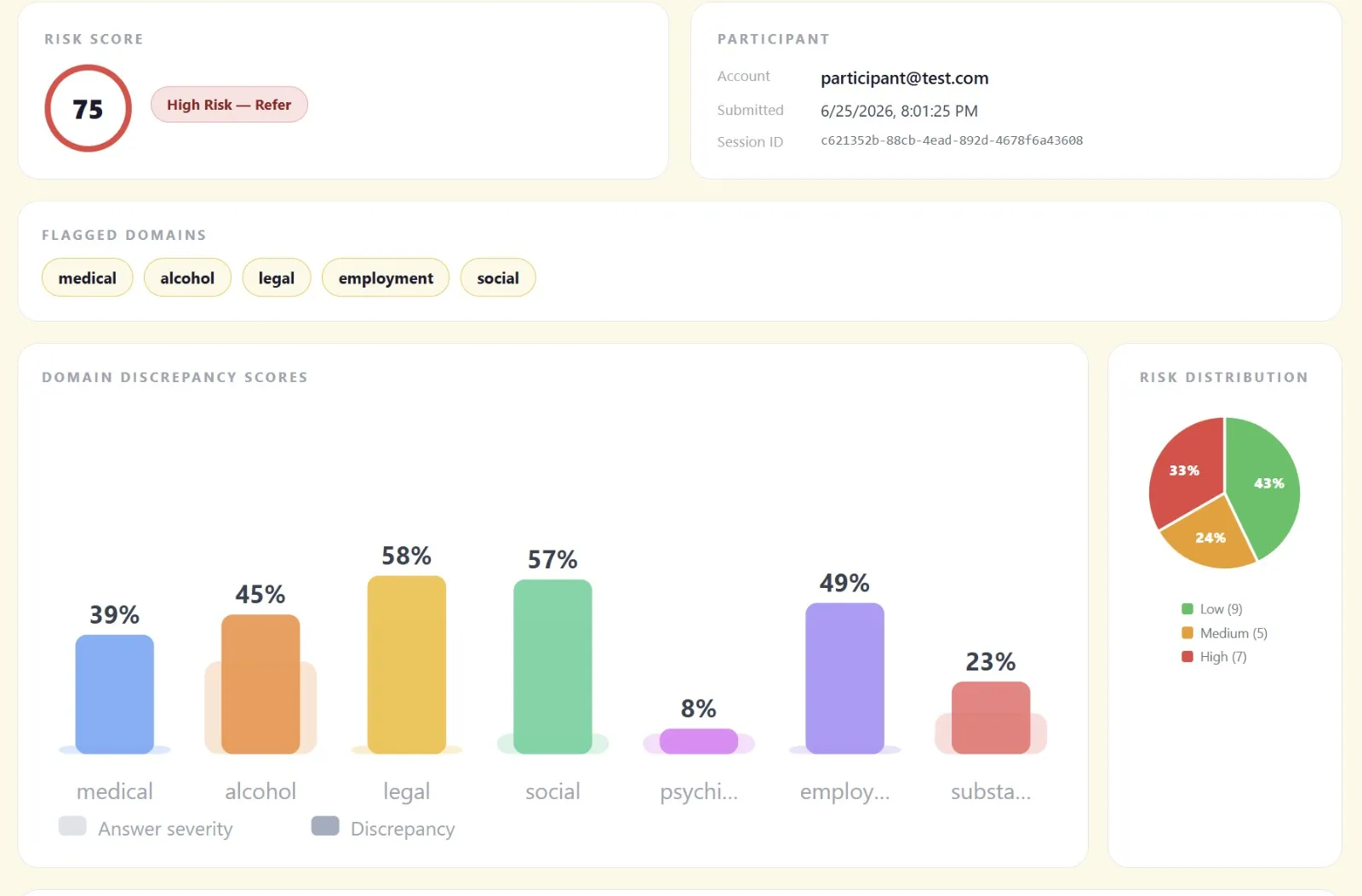
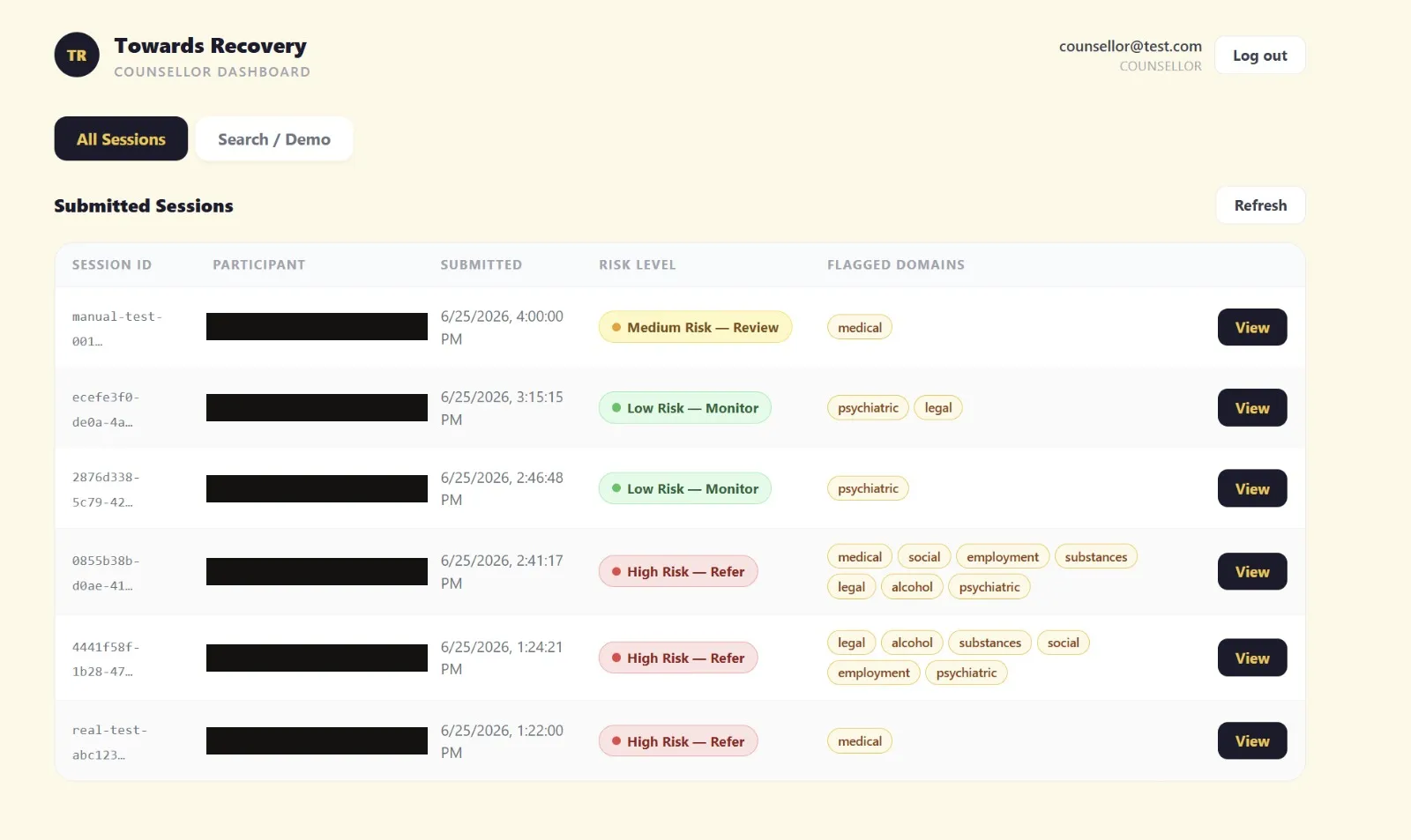
- A deterministic risk score places each session in one of three tiers: monitor, review or refer.
- People in the monitor tier check in over time. Drift detection escalates them to review after a sustained change across two readings in a row.
- Counsellors see the live tier, the flagged domains and an optional written summary.
Design decisions
- Face-to-answer mismatch is treated as an inconsistency for a human to look at, never as lie detection. Nothing is acted on automatically.
- The camera is optional. The score still works on answers alone.
- The language model only writes the counsellor’s summary. Everything else works without it.
My part
- Built with the team for Game of Code 2026. The project won second prize.
More screenshots

Not done yet
- Only one of the classifier’s twelve features comes from real session data, so it behaves close to a step function.
- Drift detection needs at least five check-ins before it says anything.
- A proof of concept. Not validated for clinical use.